
Best Salesforce Backup Solutions: How to Recover Deleted Records in Salesforce

Updated: May 29
Accidentally deleting Salesforce records happens to even the most careful users. The good news? Salesforce provides built-in tools that make it possible to restore data quickly.
But native recovery options have limits. This is especially true if you need long-term protection, compliance-ready retention, or complete Salesforce data backup.
Here is a simple guide on how to recover deleted records in Salesforce. It also covers what to consider in the best Salesforce backup solutions for better protection.
Recovering Records with the Salesforce Recycle Bin
Salesforce’s Recycle Bin acts as a safety net for recently deleted records. To restore data, log into your org, open the Recycle Bin from the profile menu, and review what’s available. Deleted records typically stay here for up to 15 days, unless your admin has adjusted retention settings.
Once you locate the record, check the box next to it and click Undelete. Salesforce will then restore it to its original location. You’ll see a confirmation message once the process is complete. It’s always best to double-check by navigating to the original object tab or list view to make sure the record is visible again. After you finish restoring records, you can empty the Recycle Bin to free up storage space.
This process is straightforward, but the limitations are important to understand. The Recycle Bin only retains records for a short period of time, excludes some related items and metadata, and can fill up quickly in large orgs. After records expire or you empty the Recycle Bin, Salesforce permanently deletes them.
Why Native Salesforce Backup and Recovery Isn’t Enough

For many organizations, 15 days of retention isn’t sufficient. Compliance requirements may call for months or even years of historical data. Business users often need access to older records for audits, forecasting, or customer service. And when data corruption or system errors occur, the Recycle Bin can’t help at all.
These gaps highlight the need for a true Salesforce backup and recovery strategy — one that covers not just recently deleted records, but your entire Salesforce environment, including both data and metadata.
What to Look for in the Best Salesforce Backup Solutions
Not all backup tools offer the same level of protection. The best Salesforce backup solutions typically include:
Automated Salesforce data backup with configurable schedules
Long-term retention for compliance and auditing
Backup coverage for both Salesforce data and metadata
Selective restore capabilities (record-level, object-level, or full org restore)
Secure storage options and encryption
Protection against corruption, failed deployments, and accidental deletion
If your organization relies on Salesforce for revenue operations, customer data, or reporting, these features aren’t “nice to have”—they’re foundational.
Extending Salesforce Backup Protection with Sesame Software
Sesame Software strengthens Salesforce’s recovery capabilities by providing secure, automated backups of both data and metadata. Unlike the Recycle Bin, our solution supports enterprise-grade backup and recovery, including:
Long-term retention, ensuring historical data is always accessible
Selective restores, so you can recover a single record, object, or the entire org
Flexible storage options, including Amazon S3, Azure, or BYOD environments
Comprehensive protection, guarding against accidental deletions, corruption, and failed deployments
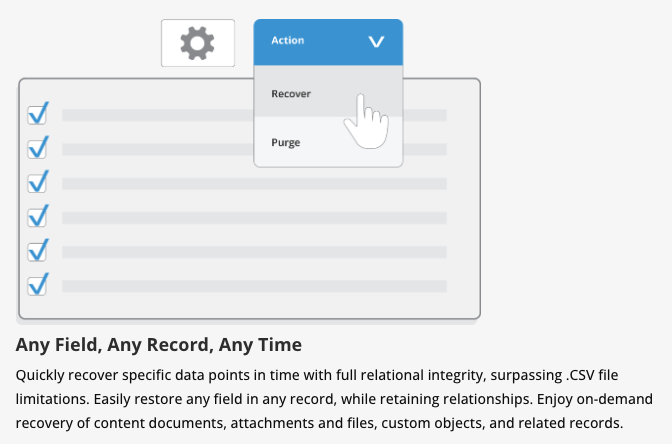
With Sesame Software, recovery is quick and precise. After connecting to Salesforce through a secure API, backups run automatically on your preferred schedule. If you need to restore a record, simply log in, choose the appropriate snapshot, and initiate recovery. Within minutes, the data is back in Salesforce — without disrupting the rest of your org.
The Bottom Line
Salesforce’s Recycle Bin is useful for quick fixes, but it isn’t designed for long-term protection or enterprise recovery scenarios. If your organization needs compliance-ready retention, reduced risk, and guaranteed recoverability, investing in one of the best Salesforce backup solutions is a must.
Sesame Software delivers a complete Salesforce backup and recovery solution designed for long-term data protection, fast restores, and enterprise-grade control.
Next Steps
Explore our Salesforce Backup & Recovery solution to safeguard data and metadata beyond the Recycle Bin.
Check out pricing to compare options and find the right fit for your team.
Talk to a Data Expert about building a Salesforce data protection strategy tailored to your organization.
Access our Salesforce Backup Best Practices PDF for actionable tips to strengthen your data protection strategy.
Read our collection of Salesforce blog articles with insights, tips, and best practices to help you maximize your Salesforce investment:
Recover Deleted Salesforce Records FAQ
How long does Salesforce keep deleted records?
By default, 15 days in the Recycle Bin (admins may extend slightly). After that, data is gone.
Can I recover Salesforce metadata?
No, Recycle Bin only covers data records, not metadata. Sesame Software backs up both.
What if the Recycle Bin is emptied?
Once emptied, Salesforce cannot recover the data. External backups are required.
How does Sesame Software restore data?
From backup snapshots — quickly, securely, and selectively (single record, object, or full org).
Found this post helpful? Share it with your network using the links below.


