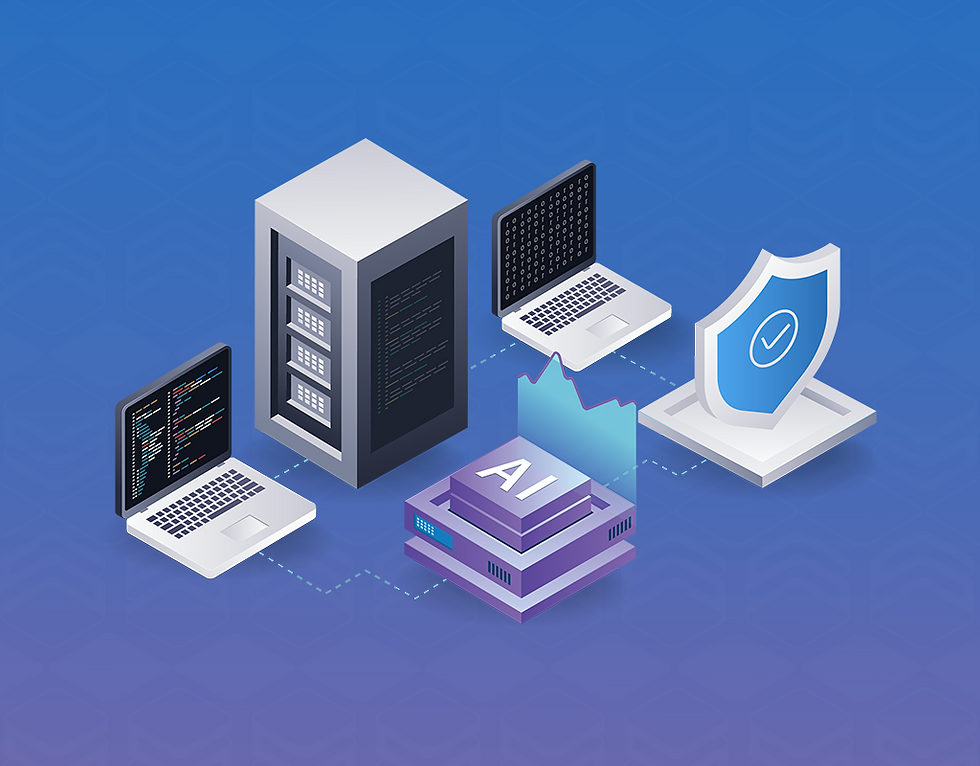
How to Build AI-Ready Datasets With Enterprise Data Preparation

Quick Answer
Enterprise AI projects fail because of data problems, not technology problems. Fragmented, ungoverned data flowing from Salesforce, NetSuite, Oracle, and other source systems into machine learning models produces predictions nobody trusts and compliance exposure nobody planned for. Building AI-ready datasets requires a structured pipeline architecture with machine learning data preprocessing built in, enterprise data governance at every stage, and complete visibility into where data comes from and how it moves. Sesame Software has spent 23+ years helping enterprise IT teams do exactly that — without writing code or managing complex infrastructure.
Why enterprise data governance is the foundation for every AI initiative
AI and machine learning models are only as good as the data feeding them. That statement gets repeated often enough that it has lost some urgency — but the operational reality for enterprise IT teams is stark.
Fragmented, unstructured data is the single biggest reason enterprise AI projects stall before they start — and every delayed deployment makes the problem more expensive to fix.
Enterprise data governance is not a checkbox exercise. It determines whether your AI models train on reliable data or inherit the inconsistencies buried across your source systems. Without governance controls in place, enterprise data pipelines become a liability. Duplicate records, mismatched schemas, and orphaned fields flow downstream into your data warehouse and eventually corrupt your machine learning models. The result is predictions you cannot trust and compliance risks you cannot afford.
Effective enterprise data governance for AI requires three foundational capabilities working together. Lineage tracking gives you a precise record of where each data point originated and how the pipeline transformed it at every stage. Access controls ensure only authorized processes and users touch sensitive data at any point in its journey.
Audit trails document every change, every access event, and every schema modification — creating the compliance record that GDPR, HIPAA, CCPA, and SOX audits require.
Sesame Software weaves governance into every stage of data movement. Built-in audit trails, role-based access control, and complete pipeline visibility come standard. Your data stays in your own environment — on your infrastructure, under your control, with no Sesame Software infrastructure in the data path.
Step 1: Assess your current data landscape
Before building AI-ready datasets, enterprise IT teams need a precise picture of the data they are working with. Most enterprise environments have data scattered across Salesforce, NetSuite, Oracle, Microsoft Dynamics, and dozens of other platforms. Each system operates on its own schema, its own update frequency, and its own set of data quality challenges.
Start by inventorying your source systems and answering the questions that shape your pipeline architecture. Which systems contain the data your AI models need? How frequently does each source update? What data quality issues exist in each system — duplicates, missing fields, inconsistent formats? What compliance requirements govern each data type?
With 20+ pre-built connectors, Sesame Software connects to your existing systems so your team can start extracting data immediately — no custom code, no waiting on native integrations. The connector library covers the enterprise source systems that matter most: Salesforce, NetSuite, Oracle, Microsoft Dynamics, DB2/AS400, SQL Server, and all major cloud data warehouse destinations.
Step 2: Establish data quality controls at the source
Data quality for AI is not something you fix at the end of the pipeline. Your team needs to enforce it at every stage, starting at the source. The most common data quality problems that derail enterprise AI projects are predictable — and preventable.
Duplicate records create multiple entries for the same customer, product, or transaction, producing inflated counts and skewed model training. Inconsistent formatting — dates in different structures, phone numbers without standardization, currency values without consistent notation — breaks model expectations silently. Missing values create null fields that break model training or produce statistically meaningless outputs. Stale data — records that have not been updated and no longer reflect operational reality — teaches models patterns that no longer exist.
Sesame Software's data pipelines include built-in data cleansing, filtering, normalization, and enrichment. Define quality rules once and the pipeline enforces them automatically, catching issues before they reach your data warehouse or ML training environment. Quality control at the source is what separates pipelines that produce trustworthy AI datasets from pipelines that produce plausible-looking problems.
Step 3: Design your data pipeline architecture for AI
A well-designed machine learning data pipeline moves data from source systems to your analytics or AI environment while preserving metadata, relationships, and historical integrity — the full context that makes data meaningful for AI-ready data infrastructure.
The architectural decisions your team makes at this stage determine the reliability, scalability, and compliance posture of every AI workload the pipeline supports.
Replication frequency is the first decision. Sesame Software replicates data as frequently as every five minutes, giving your team the flexibility to match pipeline cadence to your specific use case — near real-time for operational AI applications, scheduled batch for model training workloads where latency is less critical.
Schema management is the second. Sesame Software automatically aligns schemas with dynamic table creation and column addition, keeping your destination synchronized with every source change without requiring manual intervention or developer time. When a new field appears in Salesforce or a custom record type is added in NetSuite, the pipeline adapts automatically.
Storage location is the third. Sesame Software's self-hosted deployment model keeps your data on your own infrastructure — on-premise, private cloud, or your own cloud accounts — with no data processed on Sesame Software's servers. For enterprise IT teams with data residency obligations or internal policies restricting third-party data access, this architecture satisfies those requirements by design.
Sesame Software's visual pipeline designer lets your team build and automate these workflows without coding, reducing dependency on engineering resources and accelerating time to value for AI initiatives.
Step 4: Implement data engineering for ML governance throughout the pipeline
Sesame Software weaves governance into every stage of data movement — not as a layer added after the pipeline is built, but as a structural component of how data moves from source to destination.
For enterprise IT teams operating under regulatory requirements, this means encryption at every stage. Sesame Software uses TLS 1.2 or higher for data in transit and AES-256 for data at rest. Role-based access control lets your team define precisely who can view, modify, or export data at each stage of the pipeline — at the object level, the field level, and the operation level.
Comprehensive audit trails document every transformation, every access event, and every schema change, producing the compliance record that regulatory audits require. With SOC 2 Type II certification and support for GDPR, HIPAA, CCPA, and SOX, Sesame Software produces the compliance documentation your team needs — no manual tracking, no spreadsheet-based audit workflows.
The audit trail is produced by the platform, stored in your own environment, and accessible to compliance and legal teams without requiring technical data extraction.
Step 5: Apply data preprocessing for AI before model training
Before data reaches machine learning models, it needs a final quality gate. This validation step catches anything that slipped through earlier controls and confirms the dataset meets your model training requirements before it enters a production environment.
Effective validation covers four areas.
Completeness checks confirm required fields are populated across the full dataset — not just the sample your team used during development.
Consistency verification ensures data follows expected formats and value ranges across every record.
Relationship integrity validation confirms that parent-child relationships between records are preserved and that no orphaned records exist in the training dataset.
Statistical profiling identifies outliers or anomalies that could skew model performance in ways that are difficult to diagnose after deployment.
Sesame Software preserves metadata and parent-child relationships during extraction and transformation, so your AI-ready datasets carry the relational context your models need to make accurate predictions. The relational integrity that makes Salesforce and NetSuite data meaningful in their source systems travels with the data into your AI environment.
Step 6: Establish continuous monitoring and maintenance
Building data quality for machine learning datasets is not a one-time project. Source systems change, new data sources come online, and data quality drifts over time. Your governance framework needs continuous monitoring and maintenance built into its operating model from day one.
A sustainable approach combines automated pipeline monitoring with regular data profiling and version control for transformation logic. Automated monitoring generates alerts when data flows fail, schemas change unexpectedly, or quality thresholds are breached — before those issues reach production AI workloads. Regular data profiling catches quality drift before it affects model performance. Version control for transformation logic tracks every change to your pipeline configuration for troubleshooting and compliance documentation.
Sesame Software's architecture scales automatically alongside your data growth, handling high-volume data and large-scale replication without performance degradation. The 15 proprietary patents powering Sesame Software's hyper-threaded replication engine provide the throughput that production AI workloads require — processing hundreds of millions of records without the sequential bottlenecks that limit conventional pipeline architectures.
Common mistakes that derail enterprise AI data preparation
The mistakes that sink enterprise AI data preparation projects are consistent across organizations and almost always avoidable.
Treating data preparation as a one-time task is the most common. AI models require fresh, accurate data to maintain performance over time. Teams that build pipelines for a single training run and then rely on periodic manual refreshes discover the problem when model accuracy degrades and nobody can explain why. Build pipelines that update datasets automatically and continuously, with monitoring that confirms the update is running correctly.
Ignoring data lineage until something breaks. When model predictions go wrong — and in production, they will — tracing the issue back to its data source requires lineage tracking implemented before the problem occurred, not after. Your team needs lineage tracking from day one to audit and debug effectively when the question arises.
Underestimating storage and compute requirements at scale. AI-ready datasets grow quickly as source systems accumulate records and pipeline frequency increases. Choose infrastructure and pipeline architecture that scales with data volume without requiring re-architecture when growth exceeds initial estimates.
Skipping governance controls to accelerate initial deployment is the fourth — and most expensive mistake to remediate. Access controls and audit trails cut for speed create compliance exposure that surfaces during audits rather than during development. Build governance into the foundation of every pipeline, regardless of timeline pressure.

Why Sesame Software is built for enterprise AI data preparation
Enterprise AI initiatives succeed or fail based on the quality and governance of the data feeding them. The organizations that get this right build structured, automated pipelines that maintain data quality, enforce compliance, and scale without friction as AI workloads grow.
Sesame Software gives enterprise IT teams a platform to build, automate, and govern data pipelines — without writing code, managing complex infrastructure, or making compromises on security. With 15 proprietary patents powering our replication engine, SOC 2 Type II certification, and support for hybrid and multi-cloud architectures, Sesame Software helps enterprise IT teams build AI-ready datasets with full control over where data lives and how it is governed.
With 23+ years of enterprise data management expertise, Sesame Software scales to enterprise data volumes without performance degradation — and without billing surprises, thanks to predictable connector-based annual pricing that never grows with your record counts.
Your data stays yours. Setup takes minutes. Pipelines scale automatically.
If you're ready to take back control of your data infrastructure and build AI-ready datasets, talk to a Sesame Software data expert today.

Enterprise Data Preparation for AI Frequently Asked Questions
What makes a dataset AI-ready?
An AI-ready dataset is clean, complete, consistently formatted, and structured for machine learning model consumption. It includes validated data with preserved relationships, documented data lineage, and governance controls that satisfy applicable regulatory frameworks. Sesame Software helps enterprise IT teams build these datasets by automating quality controls, preserving metadata, and maintaining relational integrity throughout every stage of the data pipeline.
How does enterprise data governance affect AI model performance?
Enterprise data governance directly determines AI model accuracy and reliability. Poor governance allows inconsistent, incomplete, or incorrectly formatted data into model training — producing unreliable predictions that cannot be diagnosed or corrected without lineage tracking. Strong governance ensures models train on trustworthy data with documented lineage, validated quality, and access controls that prevent unauthorized modification. Sesame Software's built-in audit trails and role-based access controls support governance requirements across GDPR, HIPAA, CCPA, and SOX.
Can enterprise IT teams build AI-ready datasets without coding expertise?
Yes. Sesame Software's visual pipeline designer lets your team build automated data workflows without writing code. Connect to source systems, define quality rules, configure governance controls, and schedule data movements through a no-code interface. This reduces engineering dependency and compresses deployment timelines from months to days.
How often should your team refresh AI training datasets?
Refresh frequency depends on your use case and how quickly source data changes. For operational AI applications where model inputs change continuously, near real-time updates may be necessary. For periodic model retraining workflows, scheduled batch refresh at daily or weekly intervals may be sufficient. Sesame Software supports replication as frequently as every five minutes, giving your team the flexibility to match cadence to specific requirements without sacrificing data quality or governance controls.
What compliance frameworks apply to AI data preparation?
Enterprise AI initiatives fall under the same compliance regulations as all other data management activities — including GDPR, HIPAA, CCPA, and SOX. These frameworks require audit trails, access controls, and data lineage documentation throughout the data lifecycle. Sesame Software's SOC 2 Type II certification and built-in compliance features help enterprise IT teams meet these requirements without manual tracking or retrospective documentation.
How does Sesame Software handle schema changes in source systems?
Sesame Software detects schema changes in source systems automatically — new fields, new objects, modified data types — and propagates those changes to the destination environment without manual intervention. Dynamic table creation and automatic column addition keep the destination synchronized with source changes continuously, so AI training datasets reflect the current structure of source systems without requiring developer time or pipeline downtime.
Found this post helpful? Share it with your network using the links below.