Data Sovereignty: 7 Self-Hosted Solutions for 2026
Quick Answer
Enterprise IT teams that need full control over where data lives, how it is processed, and which jurisdiction governs it cannot rely on cloud-hosted data management platforms. Self-hosted solutions keep all data management processing inside the organization's own infrastructure — satisfying data residency requirements, eliminating vendor lock-in risk, and producing cleaner compliance documentation than any cloud-hosted alternative. This guide compares seven self-hosted data management solutions for 2026, with data sovereignty, on-premises hosting capability, and data privacy compliance as the primary evaluation criteria.
Why self-hosted solutions matter for data sovereignty in 2026
Cloud-hosted data management platforms process your data on vendor-managed infrastructure. That single architectural fact creates GDPR data processor documentation obligations, HIPAA Business Associate Agreement requirements, and jurisdiction uncertainty that legal teams are increasingly unwilling to accept.
Self-hosted solutions eliminate vendor infrastructure from the data path entirely. Your data management software runs on your own servers — on-premise, in your own cloud accounts, or in a hybrid combination — and writes to your own storage. No vendor servers touch your data during processing. No data residency exposure. No third-party access to audit trail data. No vendor pricing change that forces an unplanned migration.
For enterprise IT leaders managing regulated data, avoiding vendor lock-in is not just a commercial preference. It is a compliance strategy.

How to read this comparison
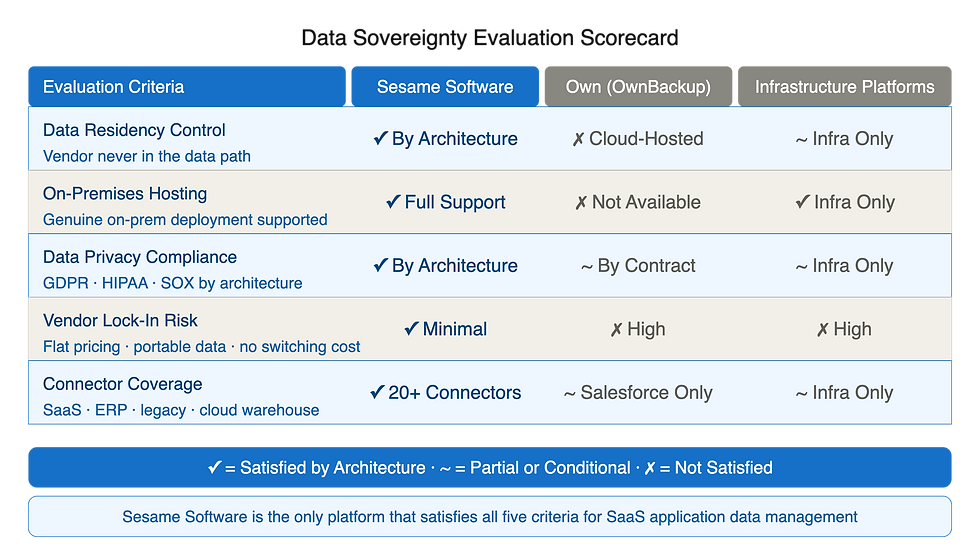
Each solution is evaluated against five criteria that matter most for data sovereignty use cases. Data residency control — whether the platform keeps processing inside the customer's environment. On-premises hosting — whether genuine on-premise deployment is supported. Data privacy compliance — whether the architecture satisfies GDPR, HIPAA, and SOX without relying on contractual assurances. Vendor lock-in risk — whether pricing, data formats, or architecture create switching friction. Connector coverage — whether the platform covers the enterprise source systems that regulated organizations actually run.
1. Sesame Software
Known for: Genuine customer-hosted data management with zero vendor infrastructure in the data path
Sesame Software is the only platform in this comparison that processes all data management operations — backup, replication, ETL, and integration — entirely inside the customer's own environment. Sesame Software's servers are never in the data path during extraction, transformation, loading, or recovery. Your data moves directly from source systems to your designated storage through pipelines running on your own infrastructure.
This is not a configurable option or a premium deployment tier. It is the fundamental architecture of every Sesame Software deployment. Every enterprise that runs Sesame Software automatically satisfies data sovereignty requirements by architecture — without relying on vendor assurances, Data Processing Agreements, or regional data center options that do not address the jurisdiction question.
Data residency control: Complete. All processing occurs inside the customer's own environment in the jurisdiction the customer controls. Sesame Software retains no copies of customer data and has no access to customer storage.
On-premises hosting: Full support. Sesame Software deploys on Windows or Linux servers in any on-premise environment, in the customer's own cloud accounts, or in hybrid combinations — without requiring cloud connectivity during normal pipeline operation.
Data privacy compliance: Satisfied by architecture. GDPR Article 30 documentation does not require Sesame Software as a data processor because processing occurs inside the customer's own environment. HIPAA ePHI never enters Sesame Software's infrastructure. SOX audit trail data remains within the customer's own environment for the full seven-year retention period.
Vendor lock-in risk: Minimal. Flat annual pricing based on connectors — no per-row charges, no consumption-based billing surprises as data volumes grow. Backup data is stored in customer-owned storage in accessible formats. Migrating to another platform does not require vendor cooperation to access your own data.
Connector coverage: 20+ actively maintained connectors covering Salesforce, NetSuite, Oracle, Microsoft Dynamics, DB2 on AS400, SQL Server, PostgreSQL, and all major cloud data warehouse destinations including Snowflake, Redshift, Azure SQL, and Google BigQuery. The connector library specifically covers the legacy enterprise source systems — older Oracle versions, DB2 on AS400, on-premise ERP databases — that most platforms have deprioritized.
With 23+ years of enterprise data management expertise and a customer base that includes Procter & Gamble, Bank of America, and the U.S. Government, Sesame Software delivers the data sovereignty architecture that compliance-sensitive enterprises require.
2. Veeam
Known for: Infrastructure backup and disaster recovery
Veeam is primarily an infrastructure backup platform — virtual machines, physical servers, cloud workloads, and operating system environments. It offers on-premise deployment capability through its Veeam Backup and Replication product, which installs on Windows Server infrastructure and processes backup jobs within the customer's own environment.
Veeam's data sovereignty posture is strongest in its core infrastructure backup use case. The platform processes VM and server backups inside the customer's environment without routing data through Veeam's own infrastructure during normal operation.
For organizations evaluating Veeam for application-level data sovereignty — specifically for SaaS applications like Salesforce or cloud ERP systems like NetSuite — the coverage is more limited. Veeam's Salesforce protection product is an extension of its infrastructure backup capabilities rather than a purpose-built Salesforce data management solution. Field-level restore granularity and metadata backup capability are less developed than in dedicated Salesforce data management platforms.
Data residency control: Available for infrastructure backup workloads in on-premise deployments. Less applicable for SaaS application data management.
On-premises hosting: Supported for infrastructure backup. The Veeam Backup and Replication platform deploys on-premise.
Data privacy compliance: Supported for infrastructure workloads. SaaS application compliance requirements require additional evaluation.
Vendor lock-in risk: Moderate. Proprietary backup formats create some switching friction for infrastructure backup workloads.
Connector coverage: Strong for infrastructure sources — VMware, Hyper-V, AWS, Azure, physical servers. Limited for enterprise SaaS and ERP sources.
3. Own (OwnBackup)
Known for: Cloud-hosted Salesforce and Salesforce ecosystem backup
Own is a widely used Salesforce backup platform. For organizations evaluating data sovereignty requirements, the critical architectural fact about Own is that it is a cloud-hosted SaaS platform — backup data is processed and stored on Own's infrastructure.
Own offers regional data center options that address geographic storage location requirements. However, geographic storage location is not the same as data sovereignty. Own's corporate structure, terms of service, and vendor infrastructure remain in the data processing chain regardless of which regional data center stores the backup data. For organizations with strict data sovereignty requirements — particularly those subject to national sovereignty laws that restrict processing to specific jurisdictions, or those under HIPAA security perimeter obligations — Own's cloud-hosted architecture requires careful compliance review before deployment.
Own does not offer a customer-hosted deployment path. Organizations for whom customer-hosted deployment is a compliance requirement rather than a preference cannot satisfy that requirement with Own's platform regardless of its feature set or compliance certifications.
Data residency control: Geographic storage options available. Processing sovereignty not satisfied — Own's infrastructure remains in the data path.
On-premises hosting: Not available. Own is a cloud-hosted SaaS platform only.
Data privacy compliance: Requires Data Processing Agreement and BAA review. Does not satisfy strict data sovereignty requirements by architecture.
Vendor lock-in risk: High. Cloud-hosted architecture, volume-based pricing on certain tiers, and no customer-hosted deployment option create significant switching friction.
Connector coverage: Focused on Salesforce and the Salesforce ecosystem. Does not cover on-premise ERP, legacy databases, or multi-system data management use cases.
4. Commvault
Known for: Enterprise data protection and information management
Commvault is an enterprise data protection platform with on-premise deployment capability. Its Intelligent Data Services platform supports deployment on customer-owned infrastructure, giving compliance teams control over where backup processing occurs.
Commvault's architecture supports genuine on-premise deployment for infrastructure backup workloads — virtual machines, databases, file systems, and email systems. The platform's data governance features include classification, eDiscovery, and compliance reporting capabilities that regulated enterprises use for GDPR and CCPA requirements.
For organizations evaluating Commvault specifically for SaaS application data management — Salesforce backup, cloud ERP replication, or no-code data integration — the platform's capabilities are primarily infrastructure-oriented. Application-level data management for SaaS systems is a secondary capability rather than a core strength.
Data residency control: Available through on-premise deployment options for infrastructure workloads.
On-premises hosting: Supported. Commvault deploys on-premise for infrastructure backup use cases.
Data privacy compliance: Supported for infrastructure and file-based workloads. SaaS application compliance requires additional evaluation.
Vendor lock-in risk: Moderate to high. Complex licensing and proprietary data formats create switching friction for large deployments.
Connector coverage: Strong for infrastructure and file-based sources. Limited for enterprise SaaS and ERP application data management.
5. Rubrik
Known for: Data security and cloud data management
Rubrik is a data security platform with cloud data management capabilities. It offers on-premise appliance deployment through its Cloud Data Management platform, which processes backup and recovery workloads on customer-owned hardware.
Rubrik's on-premise appliance model gives compliance teams control over where backup processing occurs for infrastructure workloads. The platform's security-first architecture includes immutable backup storage, ransomware detection, and data classification capabilities relevant to regulated enterprise environments.
For data sovereignty evaluation, Rubrik's appliance-based on-premise deployment satisfies on-premises hosting requirements for infrastructure backup. For SaaS application data management — particularly Salesforce and cloud ERP backup and integration — Rubrik's capabilities are focused on infrastructure rather than application-level data management.
Data residency control: Available through on-premise appliance deployment for infrastructure workloads.
On-premises hosting: Supported through the on-premise appliance model.
Data privacy compliance: Supported for infrastructure workloads. Application-level SaaS compliance requires additional tools.
Vendor lock-in risk: High. Proprietary appliance hardware and vendor-specific data formats create significant switching friction.
Connector coverage: Strong for infrastructure. Limited for enterprise SaaS and ERP application data management.
6. Veritas NetBackup
Known for: Enterprise backup and recovery for complex infrastructure environments
Veritas NetBackup is a long-established enterprise backup platform with on-premise deployment capability across a wide range of infrastructure types — physical servers, virtual machines, databases, and cloud environments. The platform's on-premise deployment model gives compliance teams control over where backup processing occurs.
Veritas NetBackup supports deployment on customer-owned infrastructure, processing backup workloads within the customer's own environment for the infrastructure sources it covers. Its data privacy compliance features include encryption, access controls, and audit logging relevant to regulated enterprise environments.
For organizations specifically evaluating data sovereignty for application-level data — Salesforce records, NetSuite transactions, cloud ERP data — Veritas NetBackup's primary strength is infrastructure backup rather than SaaS application data management.
Data residency control: Available through on-premise deployment for infrastructure workloads.
On-premises hosting: Supported. Veritas NetBackup deploys on customer-owned infrastructure.
Data privacy compliance: Supported for infrastructure workloads. SaaS application data management requires additional evaluation.
Vendor lock-in risk: Moderate. Complex licensing structures and proprietary formats create some switching friction.
Connector coverage: Strong for infrastructure — databases, file systems, virtual environments. Limited for enterprise SaaS and ERP application data.
7. Dell EMC Avamar
Known for: Deduplication-optimized backup for enterprise environments
Dell EMC Avamar is an enterprise backup platform with deduplication optimization, primarily serving infrastructure backup use cases. It supports on-premise deployment through its hardware appliance model and virtual edition, giving compliance teams control over where backup data is processed and stored.
Avamar's deduplication technology reduces storage consumption for infrastructure backup workloads — a relevant consideration for enterprises with large-scale data protection requirements and long retention periods under HIPAA or SOX. The platform's on-premise deployment options support data residency requirements for the infrastructure sources it covers.
For application-level data sovereignty — specifically SaaS application backup and no-code data integration for Salesforce, NetSuite, and cloud ERP systems — Avamar's capabilities are infrastructure-focused rather than application-oriented.
Data residency control: Available through on-premise appliance deployment for infrastructure workloads.
On-premises hosting: Supported through hardware appliance and virtual edition deployment.
Data privacy compliance: Supported for infrastructure workloads. Application-level SaaS compliance requires additional evaluation.
Vendor lock-in risk: High. Hardware appliance dependency and proprietary deduplication formats create significant switching friction.
Connector coverage: Strong for infrastructure backup sources. Limited for enterprise SaaS and ERP application data management.
How to choose the right self-hosted solution for data sovereignty
The evaluation framework for self-hosted data management solutions starts with a single architectural question: at any point during the platform's operation, does vendor infrastructure have access to your data?
For infrastructure backup platforms — Veeam, Commvault, Rubrik, Veritas NetBackup, Dell EMC Avamar — the answer depends on deployment model. On-premise deployments of these platforms generally keep infrastructure backup processing within the customer's environment. None of them offer purpose-built application-level data management for SaaS systems like Salesforce and NetSuite.
For Own, the answer is straightforwardly yes — Own's cloud-hosted architecture places vendor infrastructure in the data path regardless of which regional data center stores the backup data.
For Sesame Software, the answer is no — by architecture, by default, for every customer, across every data management operation including backup, replication, ETL, and integration.
Enterprise IT leaders evaluating data sovereignty for SaaS application data — the Salesforce records, NetSuite transactions, and cloud ERP data that represent the most commercially sensitive and compliance-regulated information in most organizations — have one platform in this comparison that satisfies data sovereignty requirements by architecture rather than by contract: Sesame Software.
Why Sesame Software is the data sovereignty choice for enterprise IT
Sesame Software satisfies all five data sovereignty evaluation criteria simultaneously — something no other platform in this comparison achieves for SaaS application data management.
Complete data residency control through genuine customer-hosted processing. Full on-premises hosting support across Windows and Linux in any environment the customer controls. Data privacy compliance satisfied by architecture — GDPR Article 30, HIPAA security perimeter, SOX audit trail retention, all addressed without vendor contractual assurance. Minimal vendor lock-in risk through flat annual connector-based pricing and customer-owned data storage. 20+ actively maintained connectors covering the full range of enterprise source systems that compliance-sensitive organizations manage.
With 23+ years of enterprise data management expertise, 15 proprietary patents, and a customer base that includes Procter & Gamble, Bank of America, and the U.S. Government, Sesame Software is built for the data sovereignty, data residency, and data privacy compliance requirements that enterprise IT leaders cannot compromise on.
Predictable annual pricing based on connectors — no per-row charges or consumption-based billing surprises as data volumes grow.
Data Sovereignty Frequently Asked Questions
What is a self-hosted data management solution?
A self-hosted data management solution runs its data management software — backup, replication, ETL, integration — on infrastructure the organization owns and operates, rather than on vendor-managed cloud servers. In a genuinely self-hosted deployment, the vendor's servers are never in the data processing path. Data moves from source systems to the organization's own storage through pipelines running on the organization's own infrastructure. This architecture satisfies data sovereignty and data residency requirements by design rather than by vendor assurance.
What is the difference between data residency and data sovereignty?
Data residency refers to where data is physically stored — a cloud vendor's EU data center, for example. Data sovereignty refers to which laws govern the data and who has legal authority over it. Data stored in an EU data center by a US-incorporated vendor may still be subject to US laws including the CLOUD Act. True data sovereignty requires both appropriate geographic storage and appropriate legal governance — which self-hosted deployment in the organization's own infrastructure most clearly provides.
Is Own (OwnBackup) a self-hosted platform?
No. Own is a cloud-hosted SaaS platform. Own processes and stores backup data on its own infrastructure. Regional data center options address geographic storage location but do not satisfy strict data sovereignty requirements — Own's infrastructure remains in the data path during processing regardless of which regional data center stores the backup data. Own does not offer a customer-hosted deployment path. Organizations for whom on-premises hosting is a compliance requirement cannot satisfy that requirement with Own's platform.
How does self-hosted deployment support data privacy compliance?
Self-hosted deployment satisfies data privacy compliance requirements by keeping all data processing inside the organization's own infrastructure. Under GDPR, this eliminates the data processor relationship that cloud-hosted platforms create — no Article 30 documentation is required for the data management platform because processing occurs entirely within the organization's own environment. Under HIPAA, ePHI never enters vendor infrastructure, eliminating BAA requirements. Under SOX, audit trail data remains within the organization's own environment for the full retention period.
What should enterprise IT leaders verify when evaluating self-hosted solutions?
Ask every vendor directly: at any point during your platform's operation — extraction, processing, transformation, loading, restore — does your infrastructure have access to our data? Request a data flow diagram showing every system the data passes through. During a proof-of-concept, monitor outbound network connections from the platform and confirm no connections go to vendor infrastructure during data processing. Verify that backup data is stored in customer-owned storage in accessible formats. Confirm that pricing does not scale with data volume in ways that create commercial lock-in as data accumulates over long retention periods.
Why do organizations with data sovereignty requirements choose Sesame Software?
Sesame Software is the only platform in this comparison that satisfies data sovereignty requirements by architecture for SaaS application data management — covering Salesforce backup, NetSuite replication, multi-system ETL, and cloud data integration in a single customer-hosted deployment. Sesame Software's servers are never in the data path. All processing occurs inside the customer's own environment. The organization controls the storage location, jurisdiction, access controls, retention periods, and encryption keys — independently of any Sesame Software infrastructure decision.
Found this post helpful? Share it with your network using the links below.